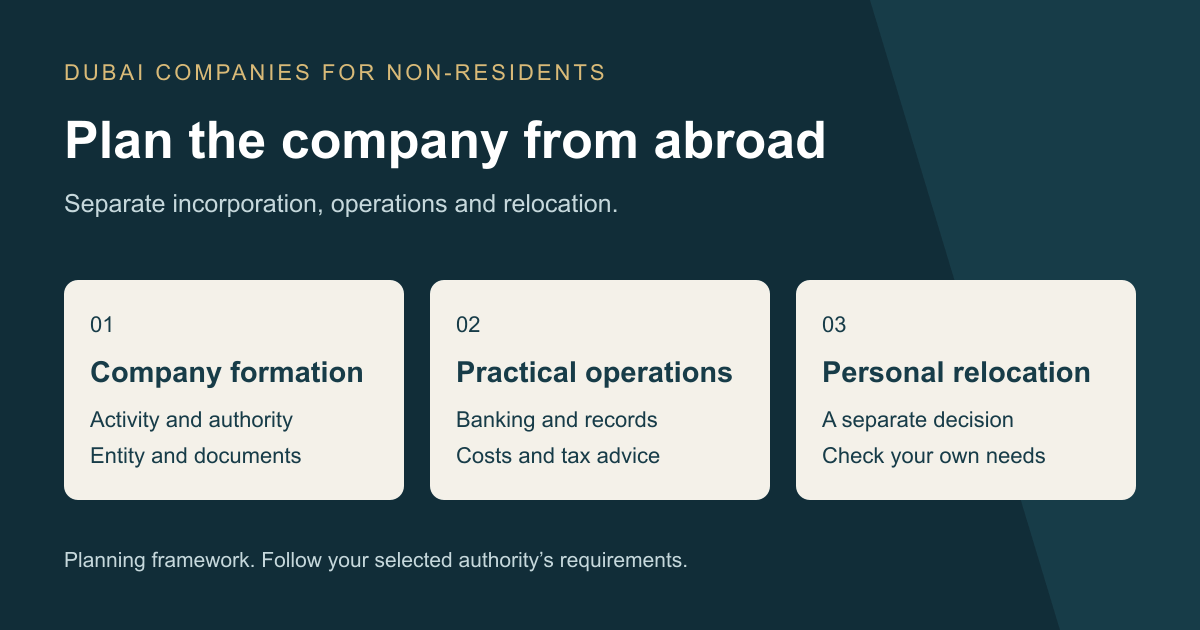
A founder who wants a Dubai company and a founder who wants to move to Dubai are buying different things. Combining both into one package can obscure which services you need now, which you may need later, and which still depend on a separate decision.
This guide is for an owner intending to remain outside the UAE, at least initially. It compares seven decisions to resolve before commissioning a setup. Official and responsible-authority sources were checked on 3 November 2026. The recommendations are a buying framework, not a promise that every applicant can use every route.
Seven decisions before buying a non-resident package
Use the same questions for each proposal. A missing answer is an unresolved part of the purchase, even when the headline price looks attractive.
| Decision | Evidence to request | Reason to pause |
|---|---|---|
| Business purpose | Written description of activities and customers | The package is chosen before the work is understood |
| Formation route | Named authority, entity and proposed activity | The quote only says “Dubai company” |
| Remote execution | Task-by-task attendance and signing plan | “Fully remote” has no defined scope |
| Banking | Bank-specific application requirements | Support is presented as approval |
| Ongoing budget | Formation, renewal and optional costs separated | Only the first payment is disclosed |
| Tax review | Advice addressing owner and company separately | Incorporation is presented as a tax exemption |
| Control | Document access and responsibility schedule | Important accounts remain inaccessible to the owner |
1. Decide what the company must do while you live abroad
Start with a short commercial brief: what you sell, where customers are located, where the work happens, who signs contracts and how customers will pay. Include any stock, physical premises or staff you expect to need. This helps distinguish a workable business structure from a licence that merely sounds relevant.
Consider two hypothetical founders. A consultant delivering reports from an overseas home office needs answers about the licensed service, customer contracts, payment collection and the tax treatment of work performed at home. A founder planning a Dubai shop needs answers about the premises and permissions for that operation. Their residence status alone does not make the same package suitable for both.
Write down why a Dubai company is necessary. Is a customer asking for a local contracting entity? Do you need a base for a planned operation? Are you investigating a future move? Ask whether the proposed structure solves that particular problem and which evidence establishes that it does.
If the provider cannot explain the connection between your activity and the proposal, request a revised recommendation. Choosing the cheapest advertised company before defining its job can leave the most consequential questions unanswered.
2. Compare the licensing authority and legal form
Dubai's official business setup overview distinguishes mainland licensing through the Department of Economy and Tourism from free zones with their own authorities and requirements. It says most mainland activities allow full foreign ownership, with exceptions for certain strategic activities. It also identifies additional approvals for some activities and company types.
For a non-resident buyer, this means “foreign ownership permitted” is only one question. Ask the selected authority to confirm the proposed activity, entity and application requirements for an owner who lives abroad. Nationality, personal residence, company jurisdiction and permission to conduct an activity are different details in the application.
A specific no-residence example
Meydan Free Zone's zero-visa guidance states that founders can form a company without taking UAE residency during incorporation and describes remote formation. That supports a specific route to investigate. It is not evidence that every Dubai authority, bank or regulated activity accepts the same arrangements.
Ask what happens if your plans change. Can the proposed company accommodate the work you expect next year? What would need a new application or an amendment? Have the authority or provider identify the relevant process instead of relying on a general statement that the package is flexible.
For a broader structural comparison, read the mainland versus free zone guide. Use it to prepare questions, then obtain a route-specific answer for the business you intend to operate.
3. Define exactly what remote setup includes
Request a written list of tasks showing who completes each one, how identity and signatures are handled, and whether attendance is required. Separate company registration from banking, immigration and any operational permissions. An online incorporation process should not be interpreted as proof that every later service can be completed remotely.
The Dubai government overview says free zone formation can mostly be completed online, while advising applicants to check the chosen zone's process. Meydan's guidance provides a more specific remote-formation example. Match the level of detail in the evidence to the claim in your quote.
Documents and representation
Ask for the current document list for your shareholder type. Tell the provider if an overseas company will own shares, if a representative will sign, or if any documents are issued in another language. Ask which documents need certification, translation or attestation and have the receiving authority's requirements confirmed before ordering those services.
Keep an attendance column beside the document list. “Electronic application” does not answer whether a later identity check, signature or other appointment needs a particular person. If an answer is uncertain, leave travel uncommitted until the responsible organisation confirms it.
Once you have selected a free zone, the free zone company formation process explains how to track the application and handover. This guide focuses on deciding whether that process fits an owner abroad.
4. Investigate banking before committing to the company
Contact the intended bank, or ask the provider to obtain its current application requirements for your proposed ownership and signatory arrangements. State clearly that you expect to remain a non-resident. A response about a different applicant profile is not enough to plan around.
Ask which identity, business and ownership evidence the bank wants, how it will verify the signatories and whether it requires attendance. Also ask about the account's currencies, payment capabilities, charges and any balance conditions. These are questions for the specific bank and product, not a universal checklist or an assurance of acceptance.
Be precise about what “banking included” means in a commercial proposal. It may describe document preparation, an introduction or application assistance. Request the deliverable, the exclusions and the contractual position if the application is unsuccessful. Do not count an application submission as an approved account.
Prepare an honest explanation of the proposed business. Identify the services or goods, expected counterparties and anticipated payment flows. Where the business has not started, label projections as projections. Do not create sample invoices that could be mistaken for completed transactions or claim customers you do not have.
If receiving payments through a particular service is essential, investigate that service before spending on the licence. An unresolved banking question may be a sensible reason to delay the purchase, even when incorporation itself appears straightforward.
5. Compare the ongoing budget, not just formation
Ask for a written comparison covering formation, recurring costs and optional future changes. Keep authority charges separate from private advisory fees and services paid to other organisations. A low first payment is difficult to evaluate when later commitments are unspecified.
Your comparison should ask about the licence, address or premises arrangement, accounting support, document services and banking charges. If you may relocate, request a separate estimate for the work that would be needed then. Treat those figures as quotations for defined services, not universal Dubai prices.
Include the cost of managing the business from abroad: professional advice where you live, secure record storage, document delivery and possible travel. Use your own circumstances to decide what belongs in the budget. An owner with an existing finance team may need different support from someone starting their first company.
The Dubai company formation cost comparison provides a wider framework for evaluating offers. For this purchase, ask each provider to price the same activity, ownership arrangement and scope. Record which figures are fixed, which are estimates and how long the quote remains valid.
Finally, ask about renewal, amendments and closure before signing. Request the relevant terms rather than assuming that a one-time setup payment covers the company's entire life. This is a purchasing recommendation, not a statement that any particular cancellation or refund right applies.
6. Review the company's tax position and your own separately
Living outside the UAE does not, by itself, settle a UAE company's corporate tax position. The Ministry of Finance corporate tax overview describes UAE-incorporated companies as broadly within the corporate tax framework and expressly includes free zone juridical persons. Do not read a marketing reference to a free zone as confirmation that your company has no tax obligations. Have a qualified adviser assess the applicable treatment and compliance work for the actual entity and activities.
Arrange a separate discussion with an adviser qualified in the country where you live and make decisions. Ask about your personal residence, work performed there, management of the overseas company, payments you receive and reporting requirements. The answers depend on the relevant country and your facts; this guide does not assume a single home-country rule.
Before incorporation, agree who will identify applicable registrations and deadlines, maintain records and handle filings. Keep the advice and supporting facts together. This article deliberately does not quote a tax rate, registration deadline or residency test because it is not determining your case.
7. Keep control of the company after incorporation
Agree on the handover before paying the final service invoice. Request the issued company documents, receipts, application references and instructions for authorised access to relevant portals. Establish who receives official correspondence and how important messages reach you while you are abroad.
Use a simple responsibility schedule. List each recurring task, the person handling it, the evidence of completion and any due date confirmed for the company. If an adviser manages a filing, decide how you will receive the submission record. Avoid leaving responsibility hidden inside a broad promise of “ongoing support”.
When reviewing a proposal from Visa Express Immigration Solutions or another provider, ask how access and records will be transferred if the engagement ends. This is a practical continuity question, not an assessment of any provider's performance. Retain copies of records the company needs and use appropriate security for identity and financial documents.
The business setup consultant comparison can help organise a shortlist. For a founder abroad, assess the written scope, communication arrangements and handover responsibilities alongside price. A clear explanation of what remains unresolved is more useful than an unsupported completion promise.
Common questions
Can I set up a Dubai company without a UAE residence visa?
Some routes allow this. Meydan Free Zone publishes a zero-visa company formation option for founders who do not relocate. Confirm the selected authority's conditions for your activity and applicant profile.
Does remote company formation guarantee a bank account?
No. Obtain the bank's own requirements and decision. A provider's promise to prepare or submit an application is not an account approval.
Does owning a Dubai company make me personally tax resident in the UAE?
Do not treat company ownership as proof of personal tax residence. Have qualified advisers assess your personal circumstances and the company's position separately.
Informational disclaimer: This is general information and a purchasing framework, not legal, immigration, banking or tax advice. Requirements depend on the authority, activity, applicant and relevant jurisdiction and can change. Confirm your case with the responsible authority and appropriately licensed professionals. No company approval, bank account, visa, tax outcome or completion time is guaranteed.