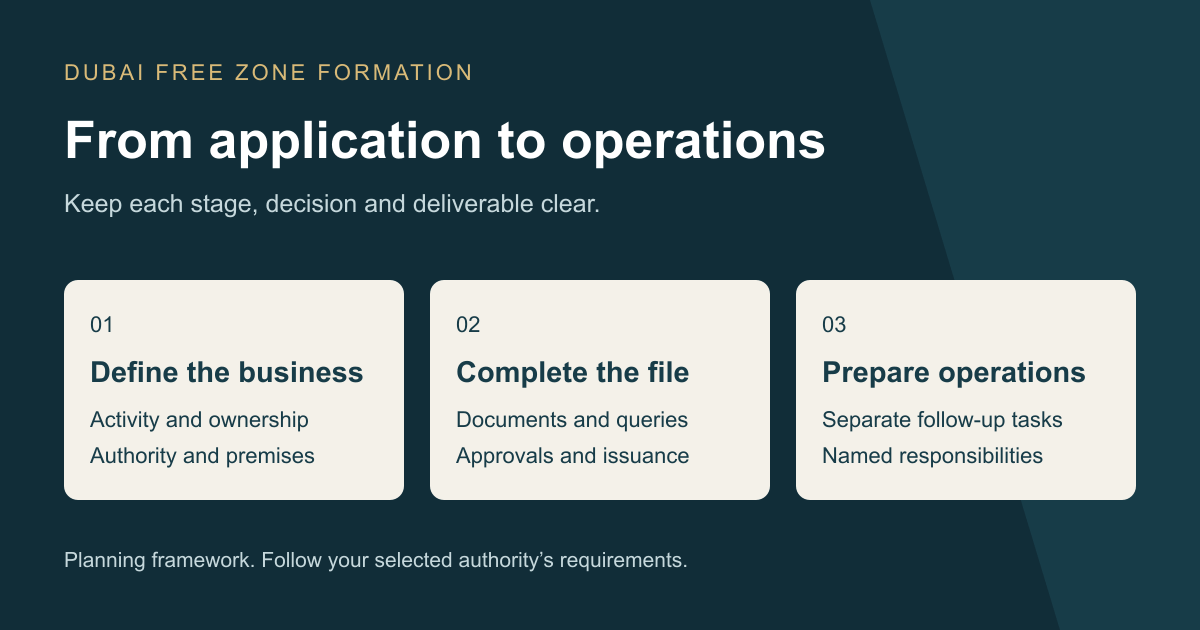
A package description rarely tells you what must happen between paying a deposit and being ready to serve customers. The useful question is: what evidence closes each stage, and who is responsible for the next one? This guide provides that working sequence, with examples from current authority materials rather than a single checklist presented as valid everywhere.
Official sources were checked on 1 November 2026. The seven stages are an editorial planning framework. Follow the authority's instructions for your application where its sequence differs. This article focuses on executing a free zone setup after shortlisting a location; it does not rank zones or quote a universal setup price.
The seven stages at a glance
Use this table as a project tracker. A submitted form, an invoice and an issued licence are different pieces of evidence. Keep them separate so that a paid invoice is not mistaken for a completed application.
| Stage | Decision or task | Evidence to retain |
|---|---|---|
| 1. Scope | Confirm activity and suitable authority | Written activity description and authority response |
| 2. Ownership | Select entity, owners and authorised representatives | Agreed ownership and signing instructions |
| 3. Documents | Obtain the route-specific checklist | Current checklist and complete document register |
| 4. Premises and costs | Confirm facility and payment terms | Accepted facility arrangement and itemised quotation |
| 5. Application | Submit, answer queries and complete conditions | Submission reference and approval correspondence |
| 6. Issue and review | Check the company documents received | Correct final documents and payment receipts |
| 7. Operations | Assign banking, residence and tax follow-up | Task owners, application references and relevant due dates |
1. Confirm the activity and the responsible authority
Describe the transactions the business will actually carry out. “Technology” is less useful than explaining whether you develop software, sell subscriptions, resell equipment or advise clients. A short description of customers, delivery and revenue gives the authority something concrete to classify.
Jafza's formation guidance distinguishes creating the entity from licensing its activities and organising its operations. It also explains that the authority determines its own procedures. Use that distinction when reviewing a proposal: incorporation alone does not answer every question about the work you intend to perform.
For practical preparation, send the same activity brief to everyone quoting for the setup. Otherwise, two apparently comparable offers may describe different businesses. Ask whether the proposed activity, customer locations or delivery arrangements raise additional approval questions. Resolve those questions before committing to a package.
If the location is still undecided, use the comparison of Dubai free zones for consultants for an initial shortlist. Return to the formation process once you have a specific authority to contact.
If the proposed structure is still unclear, review the free zone versus offshore comparison before preparing a free zone application.
Stage complete when: you know which authority will handle the application and have a written description of the activity being proposed. Keep unresolved classification questions visible.
2. Settle the entity, shareholders and signing authority
Prepare a simple ownership diagram before ordering documents. Identify each proposed shareholder, whether they are an individual or a company, their proposed holding, and the people expected to manage or sign for the new business. Do not assume that an entity label used by one zone has identical conditions in another.
The DWTC Authority FZE guide describes its Free Zone Establishment as having one shareholder, who can be an individual or a corporate entity. That is an example for the DWTC route, not a statement that every free zone setup must have one owner.
Representation deserves its own check. If someone will sign for an overseas shareholder, ask the receiving authority which authorisation it accepts and how that document must be executed. A consultant's engagement agreement should not be assumed to grant every power needed for company formation.
Discuss the proposed management arrangement with appropriate advisers while changes are still easy to make. Who approves major commitments? Which person needs access to official correspondence? Who will check the final documents? These are practical governance decisions, not merely administrative details.
Stage complete when: the owners agree on the proposed structure and the application team knows whose signatures and supporting evidence it needs.
3. Obtain a checklist for your exact application
Request the current checklist for the selected legal form and shareholder type. Save its date or version and the source from which it came. An individual-owner application and an application with a corporate shareholder should not be treated as interchangeable.
For example, DDA's FZ-LLC registration service for natural persons lists an application form, identity documents for the relevant people and an incorporation resolution. It also specifies conditional manager and representative documents. Its power-of-attorney note requires notarisation and attestation up to the UAE Embassy. Apply that detail to the named DDA service; obtain separate instructions for another route.
DWTC's FZE guide includes an ownership-information section in the application and additional corporate-shareholder records. Its notes address attestation and language requirements. If a document originates overseas, ask which requirement applies before paying for translation or attestation. Check the complete guide and any application-specific instructions, rather than relying on a summary.
A useful working register has five columns: person or entity, requested document, version received, unresolved issue and person responsible. Check spelling, passport details and consistency with the proposed ownership diagram. Restrict access to identity documents and use the submission channel agreed with the authority or appointed representative.
Stage complete when: every requested item is accounted for, and any conditional requirement has an explicit answer. An empty cell should mean “not yet resolved”, not “probably unnecessary”.
4. Confirm premises, package scope and payment terms
Describe the space you need in operational terms: desks, customer visits, stock, equipment or storage. Obtain confirmation that the proposed arrangement fits the application and planned work. Avoid choosing a facility solely from a photograph or a headline price.
Before paying, ask for an itemised proposal separating authority charges, premises costs and private service fees. Record what is included, what depends on later approval and which tasks are excluded. Ask how a change in activity, ownership or office arrangement would affect the quote.
For comparing offers, the Dubai company formation cost comparison provides a wider budgeting framework. This process guide does not publish a universal price because the application scope is not universal.
Review the payment schedule alongside the deliverables. If a payment is described as an “approval fee”, ask what the authority will actually issue at that point. Keep the written cancellation and refund terms with the quote. These are contract-review recommendations; they are not a claim that any particular refund right applies.
Stage complete when: the facility and scope are clear, the owners have reviewed the payment terms, and someone has responsibility for checking invoices against the agreed work.
5. Submit the application and close outstanding conditions
Use the selected authority's application channel and sequence. DDA's natural-person service distinguishes provisional approval from registration. This illustrates why “submitted”, “provisionally approved” and “registered” should be separate statuses in your tracker.
Keep one master copy of the submitted information. When a query arrives, record exactly what is requested, who will answer it and which version was sent back. If a shareholder, activity or manager changes, ask what must be updated before continuing with signatures or payment.
Do not turn an advertised processing estimate into a promised launch date. Request a current estimate for your route and ask when its clock starts. Does it assume a complete file, cleared payment or completed signatures? Track your own outstanding actions separately from the authority's review.
For example, a founder waiting for a corporate document from overseas should show that item as outstanding rather than describe the whole application as delayed by the free zone. This makes the next action clear without assigning blame or inventing a completion date.
Stage complete when: the application has met the conditions communicated by the authority and you have clear instructions for issuance or the next formal stage.
6. Review the issued company documents
Ask in advance which documents the selected service will deliver. DDA's service lists incorporation, commercial licensing, director-register and constitutional outputs. Another authority's package may use different names or delivery arrangements, so check against its own list.
Review the final documents against the approved application. Check the company name, legal form, registered activity wording and the relevant people and ownership records. Raise discrepancies before distributing the documents to banks, landlords or counterparties.
Retain the original electronic files and receipts in an organised company folder. Ask how authenticity can be checked and how corrections are requested. Make sure the owners can access important records and receive official messages after the formation engagement ends.
Stage complete when: the documents match the approved application, discrepancies are resolved or formally tracked, and the responsible company representative has access to the records.
7. Give each operational follow-up a named owner
Create separate tasks for banking, any intended residence applications, accounting and tax review. Ask the relevant bank or authority for the current requirements for each task. Do not use the company licence as evidence that a bank account or residence application has already been approved.
The FTA corporate tax registration service provides a separate application process through EmaraTax for persons subject to corporate tax. Review your company's registration position and applicable timeline with a qualified adviser promptly. This guide does not determine your tax status, give a tax-rate opinion or calculate a filing deadline.
For an operational handover, record the responsible person, the actual application reference where one exists, the next action and any due date confirmed for the case. “Banking support included” is not a usable status. A named contact, a document request and a submitted application reference are more useful.
When reviewing a proposal from Visa Express Immigration Solutions or another provider, request this handover in writing. The practical value is being able to see what is complete and what still requires a decision after the formation work finishes.
If you need help comparing the scope of professional support, consult the free zone setup company comparison. Assess deliverables and responsibility rather than treating marketing language as an approval commitment.
Stage complete when: each remaining task has an owner and the company knows which activities still depend on further checks or approvals.
Common questions
Is there one application process for every Dubai free zone?
No. Use the selected authority's current process for your legal form, shareholders and activity. The seven stages here are a planning framework, not a universal official procedure.
Does a company licence include an approved bank account or residence visa?
Do not treat a licence as evidence of either approval. Ask for the separate application status and requirements for banking and any residence route you intend to use.
Should I use a mainland LLC document checklist?
Use the checklist issued for your chosen free zone and entity instead. Mainland LLC paperwork is not a substitute for the relevant free zone application requirements.
Informational disclaimer: This article provides general preparation guidance, not legal, immigration or tax advice. Requirements depend on the authority, activity, structure and individual circumstances and can change. Confirm your case with the responsible authority and an appropriately licensed professional. No approval, bank account, residence status or completion time is guaranteed.